

The elevation gain of Kilimanjaro often raises questions among climbers. Climbing to high ground above 5,000m can be unnerving, especially if it is your first time.
It’s a good idea to understand how high Kilimanjaro is, what to expect, and how to prepare your body for the challenges of trekking at high altitude.
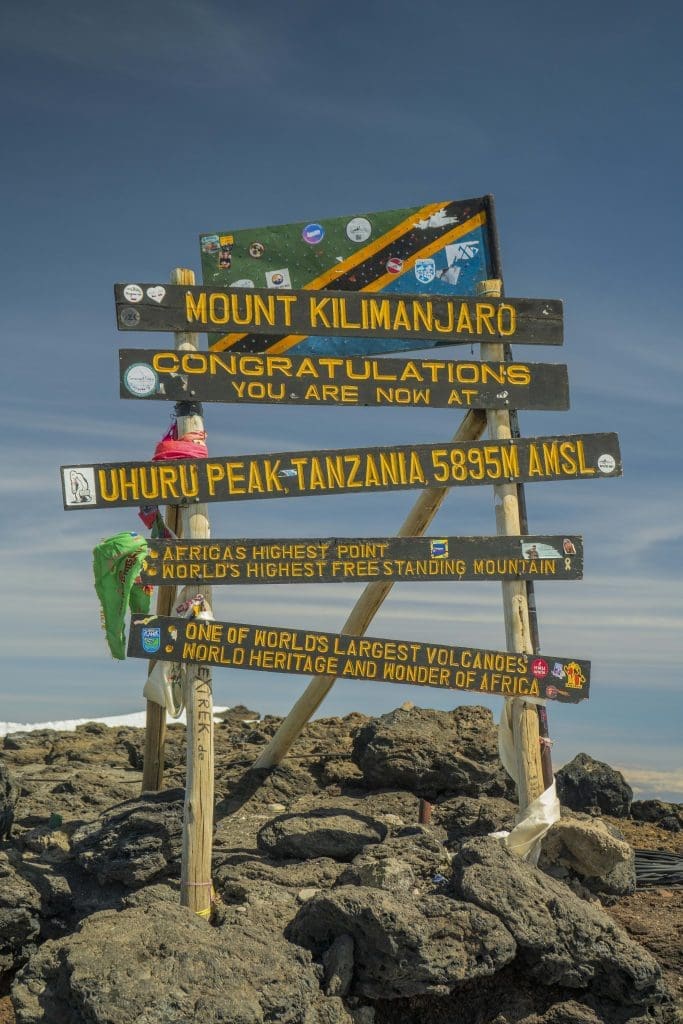
Mount Kilimanjaro’s elevation gain varies from about 1,800m to 3,000m, depending on the chosen route. Standing at 5,895m (19,341 ft) above sea level, it might seem that climbing Mount Kilimanjaro is a straight 5,895m hike from sea level, but it isn’t. Your climb usually starts much higher, which means the actual elevation gain you experience is less than the mountain’s full height.
How Long Does It Take To Climb Kilimanjaro?
Climbing Mount Kilimanjaro typically takes between five and nine days, including time spent summiting and descending back to the base. The longer you spend on the mountain, the better your chances of reaching Uhuru Peak, as your body can take time to adapt to the altitude.
Shorter itineraries, especially ones lasting five days, offer limited acclimatisation times, making it harder for climbers to comfortably reach the summit.
The time taken to summit Mount Kilimanjaro also depends on the chosen route. Some popular routes are Marangu, Umbwe, Machame, Rongai, and the Northern Circuit, each offering a different perspective of the mountain. The itinerary varies in terms of scenery and difficulty.
Here is an outline for each route, its length, and the time it takes to summit it:
Name of Route | Length of Route (km/miles) | Number of Days |
Northern Circuit/Lemosho | 66/41 | 6, 7, 8, or 9 |
Marangu | 64/40 | 5 or 6 |
Umbwe | 37/23 | 6 |
Machame | 62/37 | 6 or 7 |
Rongai | 65/40 | 6 or 7 |
Shira | 56/35 | 6 or 7 |
Although the chosen route determines the overall duration of the climb, personal experience also plays a role. Those who have spent time at high altitudes tend to acclimate more quickly to the lower air pressure, finding that each day passes more easily even though the itinerary stays the same.
What Is Kilimanjaro vs. EBC Elevation Gain?
Elevation gain is the sum of the vertical distance ascended, or how much climbing you’ll actually be doing during a hike. It is a key factor in predicting how demanding a mountain climb can be. When discussing elevation gain, Mount Kilimanjaro is often compared to the Everest Base Camp (EBC) trek—but the two climbs differ significantly in how they gain that elevation.
Mount Kilimanjaro is the tallest free-standing mountain in the world, rising rapidly from the surrounding plains, with total elevation gain varying depending on the route and starting point.
Each route begins at a different altitude, which directly affects the amount of vertical climbing required to reach Uhuru Peak. The table below shows the starting trailhead and total elevation gain for Kilimanjaro’s main routes:
Route | Starting Trailhead (m/feet) | Elevation Gain (m/feet) |
Marangu | Marangu Gate 1,879/6,164 | 4,016/13,176 |
Umbwe | Umbwe Gate 1,800/5,906 | 4,095/13,435 |
Rongai | Rongai/Nalemuru Gate (2,364/7,756) | 3,531/11,585 |
Lemosho/Northern Circuit | Lemosho Gate 2,100/6,890 | 3,795/12,451 |
Machame | Machame Gate | 4,095/14,435 |
Shira | Morum Barrier 3,407/11,178 | 2,488/8,193 |
Unlike Kilimanjaro, elevation gains for EBC are not just simple numbers; they are substantial. The total figure is not just the difference between Lukla and the base camp; it is calculated using the exact elevation profile of the entire trek.
Getting to Everest Base Camp takes about 11 days and involves a cumulative elevation gain of 7,300 meters (24,000 feet). This number is the sum of the continuous ups and downs encountered along the Himalayan terrain during the trek.
This comparison shows that climbing Kilimanjaro goes straight up to one higher point, whereas trekking to EBC involves going up and down many times over a longer distance.
What Level of Difficulty is Kilimanjaro?
It is fairly challenging to climb and summit a peak that is 19,341 feet (5,895 m) high. Apart from Kilimanjaro’s height, there are some technical aspects to climbing it. The recent breakdown of success rates on the mountain shows that about 20%–30% of climbers fail to reach the summit.
Although most climbing days on the mountain are rather straightforward, the steep paths and altitude can be challenging at times.
Physical Fitness
Physical preparation provides a favourable climbing experience. The whole process will be more difficult if you are not physically fit or prepared. Being fit does not mean you should be lifting weights; it means you can trek for hours without getting tired easily. Also, you must be able to trek for several days at a stretch, taking rest in between. As a result, physical fitness is unquestionably important for climbing the mountain.
Altitude
While preparing for the climb, it is important to understand what high altitude is and its significance. Oxygen levels decrease as you ascend, which can lead to acute mountain sickness. This significant factor is a primary determinant of climbers’ success on the peak.
Mental Preparation
Oftentimes, climbers focus on the physical preparation and neglect the mental aspect. Most people don’t realise how resilient they are until they’re in tough situations. Mental strength gives courage even when the climb becomes difficult. Some guides likewise argue that mental power and endurance are more vital than physical strength.
Weather
What makes some climbing seasons more difficult than others is the weather and temperature. The weather on the mountain can change drastically, with low temperatures. Hence, climbers sensitive to cold environments may find the expedition difficult.
Climbers usually ascend around 1,200 meters during the summit push, reaching altitudes where oxygen availability is roughly half that at sea level before descending. The trek back to the lower camp spans nearly 2,000 meters. This arduous process often lasts more than 14 hours and is usually conducted in freezing temperatures with strong winds.
Nutritions
Dehydration can make you tired easily and make the entire journey difficult. Lack of food and water may affect how quickly you adjust and acclimatise to the altitude. Going on the mountain with electrolytes, along with liquids, food, and water, helps replace the calories you are burning. Also, food will give you more energy and help you recover faster from stressful activities.
Gears
The wrong gears can make the whole hiking experience hard. Try your gears on before embarking on the journey to be sure they are comfortable. Be thorough with your Kilimanjaro packing list to avoid leaving anything behind. Wear your weighted pack and get used to adjusting it and using it with various layering types. Also, pack shoes that match each terrain and steep slope.
You can make climbing Kilimanjaro less difficult if you prepare for it. Choosing the right guide, preparation, and gear goes a long way in making your journey successful.
Can Anyone Climb Kilimanjaro?
Almost anyone can climb Kilimanjaro. According to records, an 85-year-old man, two women living with disabilities, and a 7-year-old girl have all summited Kilimanjaro. Some people, though, are not encouraged to try, such as
- People living with various cardiovascular conditions
- People living with severe breathing difficulties
Tanzanian law prohibits individuals under 8 from climbing the mountain.
In Closing
Understanding the importance of elevation gains is essential for a victorious Kilimanjaro ascent. For a successful summit, excellent mountain-climbing skills are needed, along with a trusted guide with solid experience leading climbers.
Other Frequently Asked Questions
1. Is Ascent the Same as Elevation?
Ascent is different from elevation. Ascent is the total vertical distance of every step taken during a hike.
Elevation, also known as altitude gain, is the measure of how tall a mountain is above sea level. The ascent can exceed the elevation gain because the journey up a mountain has highs and lows.
2. Has Anyone Climbed Kilimanjaro In One Day?
Four people – Karl Egloff, Killian Jornet, Simon Mtuy, and Kristina Schou Madsen – have all climbed Kilimanjaro in one day, taking about 6–10 hours. Although highly experienced climbers primarily do so, it is not advisable to climb Kilimanjaro in a single day because of the risks attached.
3. Is Kilimanjaro Harder Than Everest?
Climbers, especially those who have hiked on Everest and Kilimanjaro, often say the latter is harder than the former. Although some terrain in EBC is challenging, climbing Kilimanjaro is harder. Kilimanjaro is tough, and the mental endurance needed to summit and hike downhill for hours is high.