

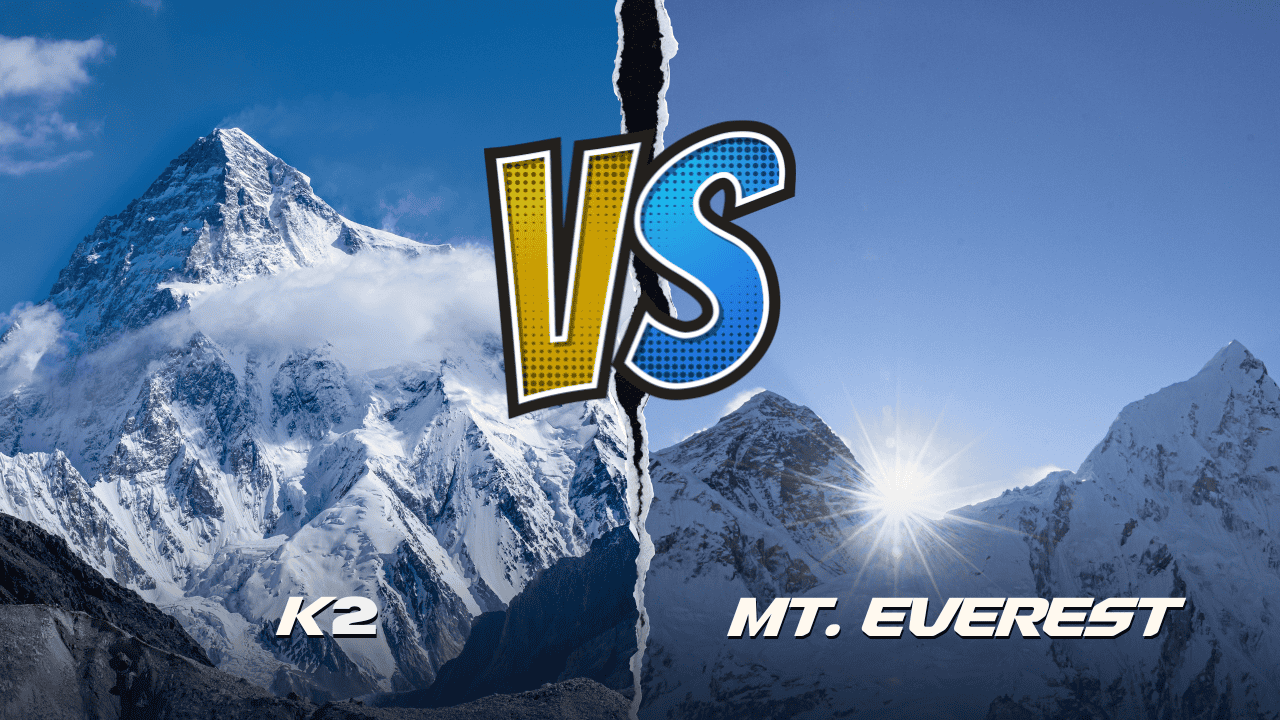
With K2 and Mount Everest being the two tallest mountains in the world, the comparison between K2 and Mount Everest is one that never ends.
Most conversations often revolve around heights, but the truth is that height doesn’t tell the whole story of K2 versus Mount Everest.
For the average person, Mount Everest is the ultimate mountaineering challenge. But experienced climbers know that isn’t wholly true.
Each Mountain represents a unique challenge. So, conquering one of the two doesn’t guarantee success in the other. Location, weather, and routes make Everest and K2 challenges of their own, not copies of each other.
Where Is Mount K2 Located?
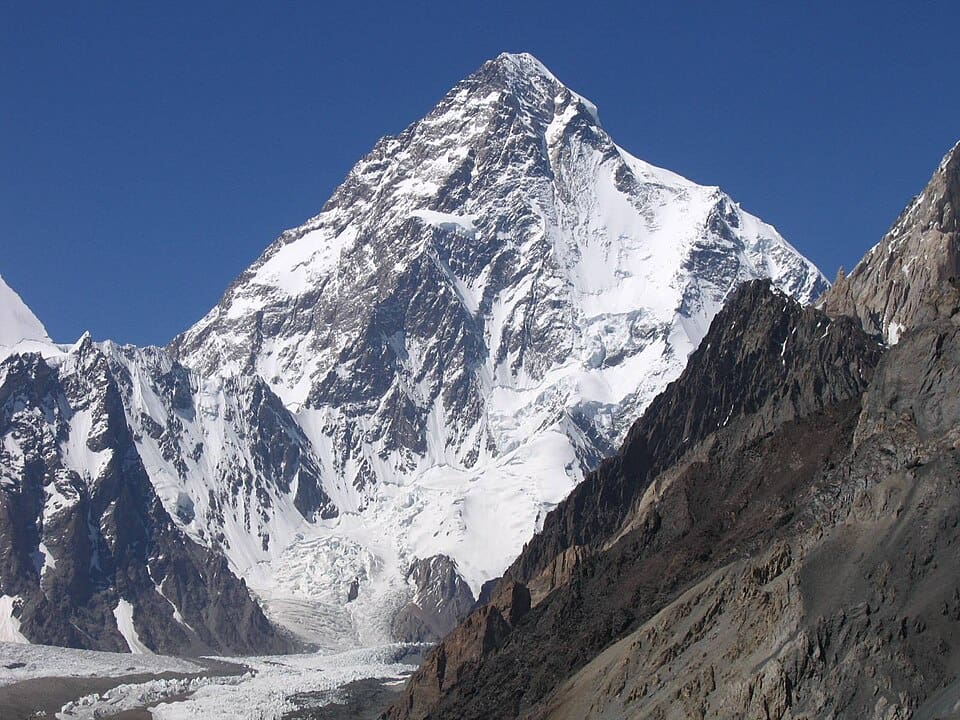
K2 is part of the Karakoram mountain range. The mountain sits between the border of Pakistan and China. Its specific position is in the Baltoro Glacier area, a remote part of the Karakoram. To reach the K2 Base Camp requires a long trek of about 90 kilometers from the nearest road in Pakistan.
The mountain’s extreme isolation presents the first significant challenge for climbers. There are no teahouses, rescue helicopters on standby, or established infrastructure in place. This means that once climbers commit to the mountain, they’re truly on their own. So, any mistake or emergency can become fatal with no quick escape route available.
Where Is Mount Everest Located?
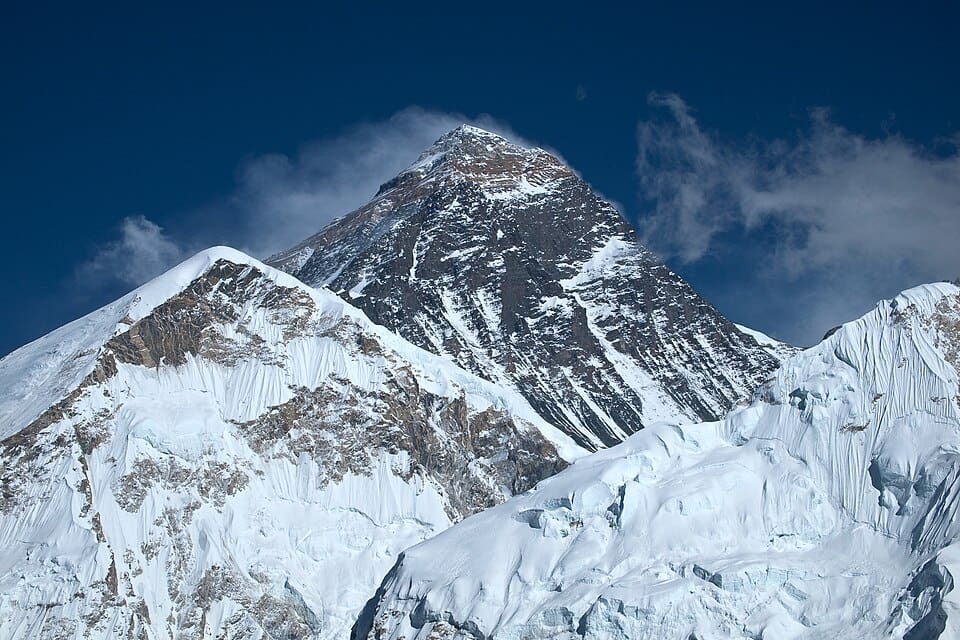
Everest is part of the Himalayan mountain range. The mountain sits on the border between Nepal and Tibet (an Autonomous Region of China).
There are several routes to reach Everest. One of the most popular routes to reach the Everest Base Camp is through the Khumbu Valley. The Khumbu Valley route is well developed with teahouses, lodges, and medical facilities. This relative accessibility has created a robust support system. Helicopter rescues are possible up to specific altitudes.
Additionally, weather forecasting is more reliable, making it easier for people to plan their trips. Usually, the climbing season sees hundreds of climbers. This creates a network of mutual support that doesn’t exist on K2. Generally, Mount Everest is more accessible than K2.
Which Is Taller, K2 Or Everest?

Mount Everest has a height of 8,849 meters, while K2 stands at 8,611 meters. That’s a 238-meter difference. However, the truth is that the difference is negligible since both are above 8,000 meters. Heights above 8,000 meters are referred to as the death zone, where oxygen levels drop to approximately one-third of those at sea level, making breathing difficult.
While the height of Everest often grabs attention, in the K2 vs. Everest conversation, the height gap matters less than the shared challenge of breathing and moving in such thin air.
Which Is Colder, K2 Or Mount Everest?
Both mountains have extreme weather conditions, but Everest is less extreme than the other.
While Everest’s weather is harsh, it is predictable. Most people who want to climb Everest wait for a short “weather window,” usually in May or September. The wind speed around these times drops below 30 km/h. Outside this period, the winds sweep across the summit at a faster speed, often reaching more than 160 km/h, especially near the summit.
The temperature on Everest is also predictable. It is usually below 0°C during the climbing season, and during winter, it drops further, reaching as low as -40°C with the constant risk of frostbite.
K2, in contrast, is not predictable. Climbers do not have the predictable weather window they get with Everest. The mountain is further north, so it experiences longer winters and shorter climbing seasons. The K2 east face is often hit the hardest by storms, with clouds covering it for days at a time. Winds are intense, and avalanches are a frequent thing. This means climbers may end up waiting at base camp with no chance to move higher.
K2’s temperature is also unpredictable. Temperatures can drop drastically overnight, and snowslides cut off routes without warning.
Physical Demand
This is one aspect of the K2 vs Mount Everest conversation that everyone agrees on. Climbing both mountains is challenging and requires specialized technical gear. But the way climbers prepare varies due to differing weather conditions.
On Everest, climbers spend weeks moving up and down the mountain before the real summit attempt. They go a little higher, then come back down to sleep, so their bodies can gradually become accustomed to lower oxygen levels. This process typically takes three to four weeks.
K2, on the other hand, gives climbers less time to prepare. The routes are steeper, there are fewer places to rest, and the weather changes rapidly. This means climbers must conserve energy and only aim higher when the team and conditions are just right.
Is Climbing K2 Harder Than Everest?
Everest has clear routes that many climbers use, with ropes already fixed in place. Sherpas also guide climbers and assist with carrying supplies, making the climb less stressful. The most common path is the South Col route in Nepal, which passes through treacherous spots such as the Khumbu Icefall, the Lhotse Face, and the Hillary Step. While these areas are dangerous, with good preparation, they can be crossed.
Most climbers also use bottled oxygen once they climb above 7,500–8,000 meters, where the air becomes too thin to sustain life. Oxygen flow is typically set between 2 and 4 liters per minute. Climbers bring spare bottles, test their gear at base camp, and practice swapping masks while wearing gloves. They also set strict turnaround times based on the amount of oxygen remaining. This extra support makes Everest more manageable for non-expert climbers.
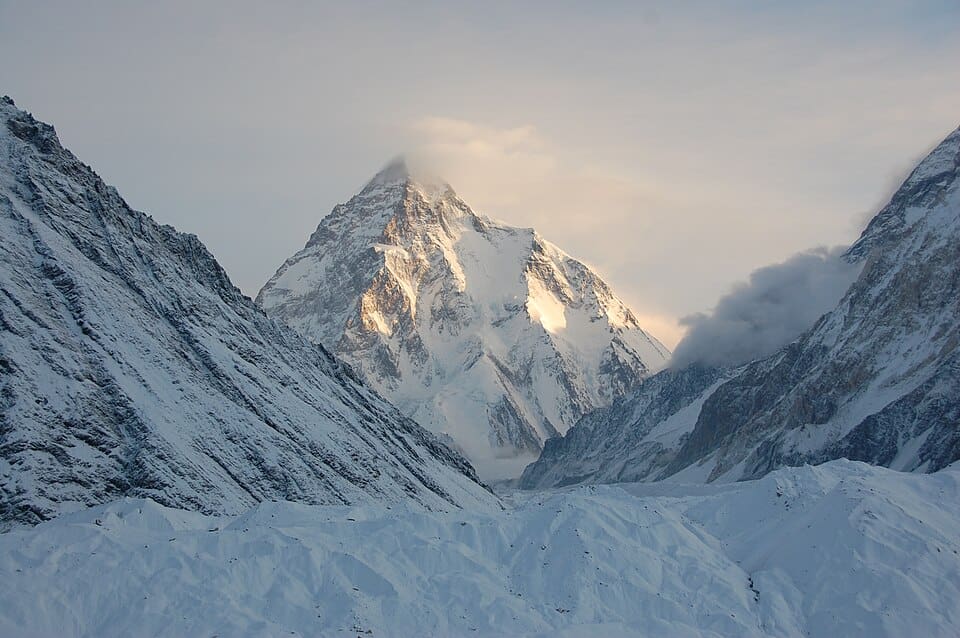
K2 is different. Its slopes are steeper, and the technical sections are longer. The main route, called the Abruzzi Spur, includes sharp ridges, rock climbs, and icy passages. Key sections include House’s Chimney, the Black Pyramid, and the Bottleneck near the summit. The Bottleneck is especially deadly because climbers must pass under huge hanging ice blocks that can fall at any time.
Unlike Everest, K2 has fewer Sherpas. Climbers must move quickly, carry their own gear, and rely only on their skills and strength. While supplemental oxygen is also used on K2, especially by guided teams, it’s not as common as on Everest, where it is a standard part of the climb for most clients.
The combination of steep terrain, changing snow conditions, and a lack of rescue support makes K2 a significantly more challenging climb. Climbing Everest is achievable for those with guidance and resources. K2 demands advanced technical skills, physical strength, and the ability to move quickly in hazardous conditions. For this reason, K2 is considered the more difficult mountain despite being shorter.
Death Rate and Success Rate
In the debate over K2 vs. Mount Everest, the numbers reveal a clear difference in danger. On Everest, more than 6,000 climbers have reached the summit, and the death rate is about 1 percent.
Most deaths happen in the “death zone” above 8,000 meters, caused by exhaustion, altitude sickness, or sudden weather changes. Rescue teams and helicopters can sometimes help at lower camps. But above base camp, climbers can only depend on themselves and their Sherpa guides. Everest also has a higher success rate, with about 60 percent of climbers reaching the top when part of well-organized teams.
K2 tells a harsher story. Only a few hundred climbers have ever reached the summit, with a success rate of between 20% and 30%. In the past, the death rate was around 20 percent, which earned K2 the nickname of being the Savage Mountain. But, in recent times, the death rate has dropped to about 13 percent, as a result of better gear and coordination.
Most attempts use the Abruzzi Spur routes, but avalanches, falling ice, and sudden storms often cut expeditions short. In fact, K2’s east face is almost untouched because of steep rock and unstable ice.
So, while Everest has extreme altitude and crowded routes, its guides, camps, and rescue options lower the danger. K2, by contrast, offers fewer safety nets and demands complete self-reliance, which is why many call it the most dangerous mountain to climb.
How much money does it cost to climb K2 vs. Mount Everest?

Getting permits to climb Everest in Nepal costs about $11,000. Then, when the costs of gear, Sherpa support, oxygen, and guiding services are added, the total cost to climb Everest ranges from $35,000 to $70,000 per person.
K2 is less commercialized but still costly. Permits in Pakistan are relatively inexpensive, at around $7,000, but total expenses can reach between $20,000 and $40,000 due to additional costs, including logistics, gear, and the services of high-altitude porters.
Everest attracts hundreds of climbers each year who are willing to pay more for better support and infrastructure. K2 has fewer climbers, and while the overall cost is lower, there are also fewer safety nets and less outside help.
Are K2 and Kilimanjaro the same Mountain?
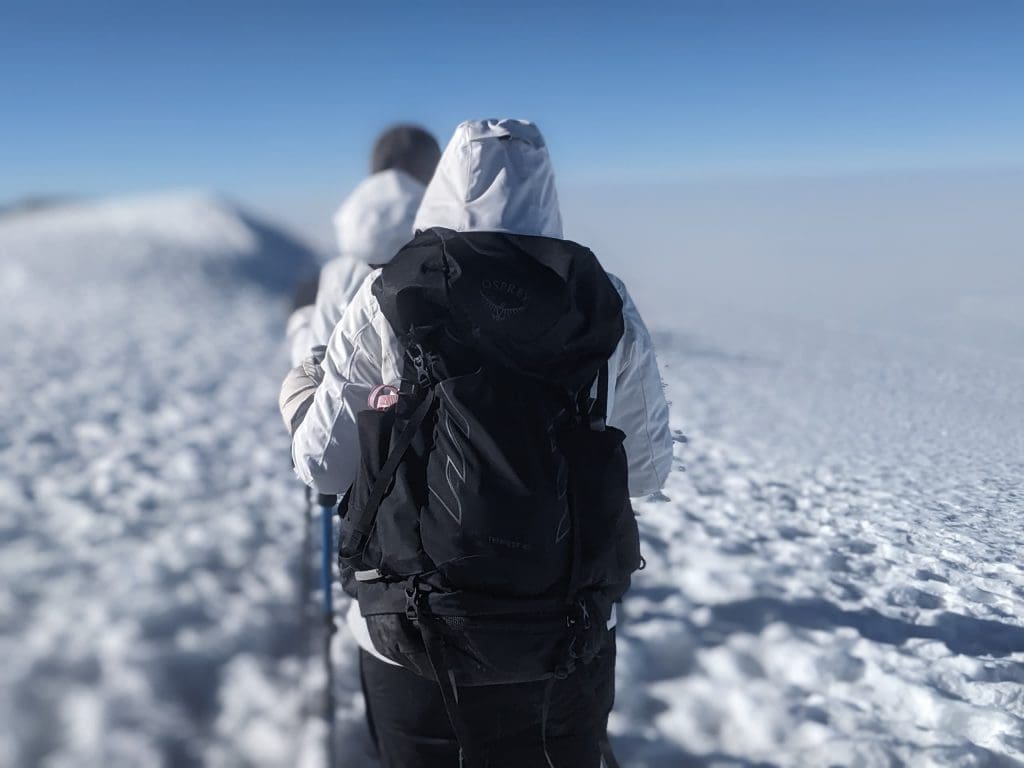
Many people often wonder if K2 is the same as Kilimanjaro. People frequently confuse these two mountains, but they are distinct. K2 stands in the Karakoram range, which spans the border between Pakistan and China, while Mount Kilimanjaro rises from the plains of Tanzania in Africa.
K2 is known for its extreme difficulty and unpredictable weather, making it one of the most dangerous climbs in the world. Kilimanjaro, on the other hand, is much more approachable. Despite being the highest mountain in Africa, Kilimanjaro climbing doesn’t require technical climbing skills. It is the perfect alternative for hikers who want to experience the thrill of high-altitude trekking without the risks associated with K2 or Everest.
Frequently Asked Questions
How Long Does It Take To Climb Everest Vs K2?
Climbing Mount Everest usually takes about two months. This period includes acclimating to the thin air, transporting supplies up the mountain, and waiting for favorable weather conditions. Most climbers arrive in Nepal around April and try to reach the top in May. K2 takes about 6 to 8 weeks, but it feels harder. The climb is steeper, the weather is worse, and teams often spend days or even weeks waiting at base camp for storms to stop.
Why Is K2 Called The Savage Mountain?
K2 is known as the Savage Mountain because it is considered one of the most hazardous mountains. The slopes are steep, the weather changes rapidly, and there is limited outside assistance. In the past, nearly one in five climbers died while attempting to reach the summit. Even today, with improved gear, it remains one of the most treacherous mountains to climb.
Which Mountain Was Climbed First, Everest Or K2?
Mount Everest was first climbed. In 1953, Sir Edmund Hillary from New Zealand and Tenzing Norgay, a Sherpa from Nepal, reached the top. K2 was climbed a year later, in 1954, by an Italian team. Lino Lacedelli and Achille Compagnoni made the final push to the summit. Everest was first because its main route is a little easier compared to K2’s challenging and technical climb.
Can Beginner Climbers Attempt Everest Or K2?
Beginners cannot go straight to Everest. They require years of training and practice on smaller peaks, such as Island Peak, Aconcagua, and Kilimanjaro. Still, with the help of Sherpas, ropes, and bottled oxygen, some non-experts have managed to reach the summit. K2 is very different. It is not for beginners at all. Climbers must carry their own gear, face more challenging slopes, and deal with less support. Only very skilled mountaineers with experience on other high peaks should attempt K2.